
Avengers: Doomsday vs. Dune: Part Three — The Ultimate 2026 December Box Office Showdown
Doomsday
Part Three
When is the last time two generational blockbusters opened on the same day? Hollywood's most anticipated collision of 2026 is here — and neither side is blinking. On one side, the MCU's largest cast ever assembled, with Robert Downey Jr. returning not as the hero who saved the universe but as its greatest villain. On the other, Denis Villeneuve closing out his magnum opus with custom-built IMAX lenses and a galaxy of stars. This is not just a box office story. This is cinema history in the making.

Photo: Unsplash — The theatre awaits
December 18 has always been a date touched by cinema magic. Avatar shattered records on this date in 2009. Star Wars: The Force Awakens became the biggest domestic film ever on this date in 2015. Now, two studio giants have locked in for the same December 18, 2026 launch — and neither is moving.
Marvel, which originally planned a May 2026 release before pushing Doomsday to the year-end window, has a livestream countdown running. Disney insiders have called the date significant beyond negotiation. Meanwhile, Dune: Part Three had already secured a critical advantage — exclusive IMAX screens for its opening weekend across the United States.
- DirectorsAnthony & Joe Russo
- StudioMarvel Studios / Disney
- ReleaseDecember 18, 2026
- IMAXSelect international only
- SequelSecret Wars (Dec 17, 2027)
- DirectorDenis Villeneuve
- StudioLegendary / Warner Bros.
- ReleaseDecember 18, 2026
- IMAXFull 3-week US exclusivity
- NovelDune Messiah (Herbert, 1969)
The pressure on both films is enormous, but the weight falls heaviest on Marvel. The four Avengers films have collectively grossed over $7.7 billion worldwide. Endgame alone pulled in $2.799 billion — second only to Avatar's $2.924 billion all-time. Infinity War ranks seventh globally with $2.052 billion. The expectation that Doomsday must match these numbers is a bar Marvel cannot afford to miss.
Disney insiders have pointed to Barbie and the Lilo & Stitch live-action as proof that a film without IMAX can still clear $1 billion. But losing IMAX on opening weekend is a genuine commercial hit — premium-format tickets carry higher prices, and opening weekend momentum shapes a film's entire run. The "Dunesday" scenario — where both films feed each other's hype the way Barbenheimer did in 2023 — is the debate consuming cinema fans globally right now.

Photo: Unsplash — The magic of the big screen
Denis Villeneuve did not simply point IMAX cameras at the desert and call it a day. For Part Three — the conclusion to his decade-spanning vision of Frank Herbert's universe — he commissioned Atlas Lens Co. to build a custom spherical lens from scratch. Designed specifically to capture what Villeneuve described as "the essence of Arrakis," the lens introduces signature optical flares that are unique to this film, impossible to replicate with any existing optics.
The film was shot entirely with IMAX cameras, and with a three-week exclusive run in full IMAX 70mm, early presale tickets have already been selling out. The IMAX 70mm filmstrip collectible — one per ticket, while supplies last — has driven a wave of early purchases reminiscent of the presale stunt Christopher Nolan pulled for The Odyssey in 2025.
"We've got something — we're on our way."
Hans Zimmer — on scoring Dune: Part ThreeOfficial Teaser Trailer — Dune: Part Three (Warner Bros. Pictures · YouTube)
Cinematographer Linus Sandgren — who won an Oscar for La La Land — returns for Part Three. The combination of Sandgren's craft, Villeneuve's custom lens, IMAX 70mm, and Hans Zimmer's score makes this the most technically ambitious chapter of the Dune trilogy. For cinephiles, this is the rare film where the format is as much the event as the story itself.

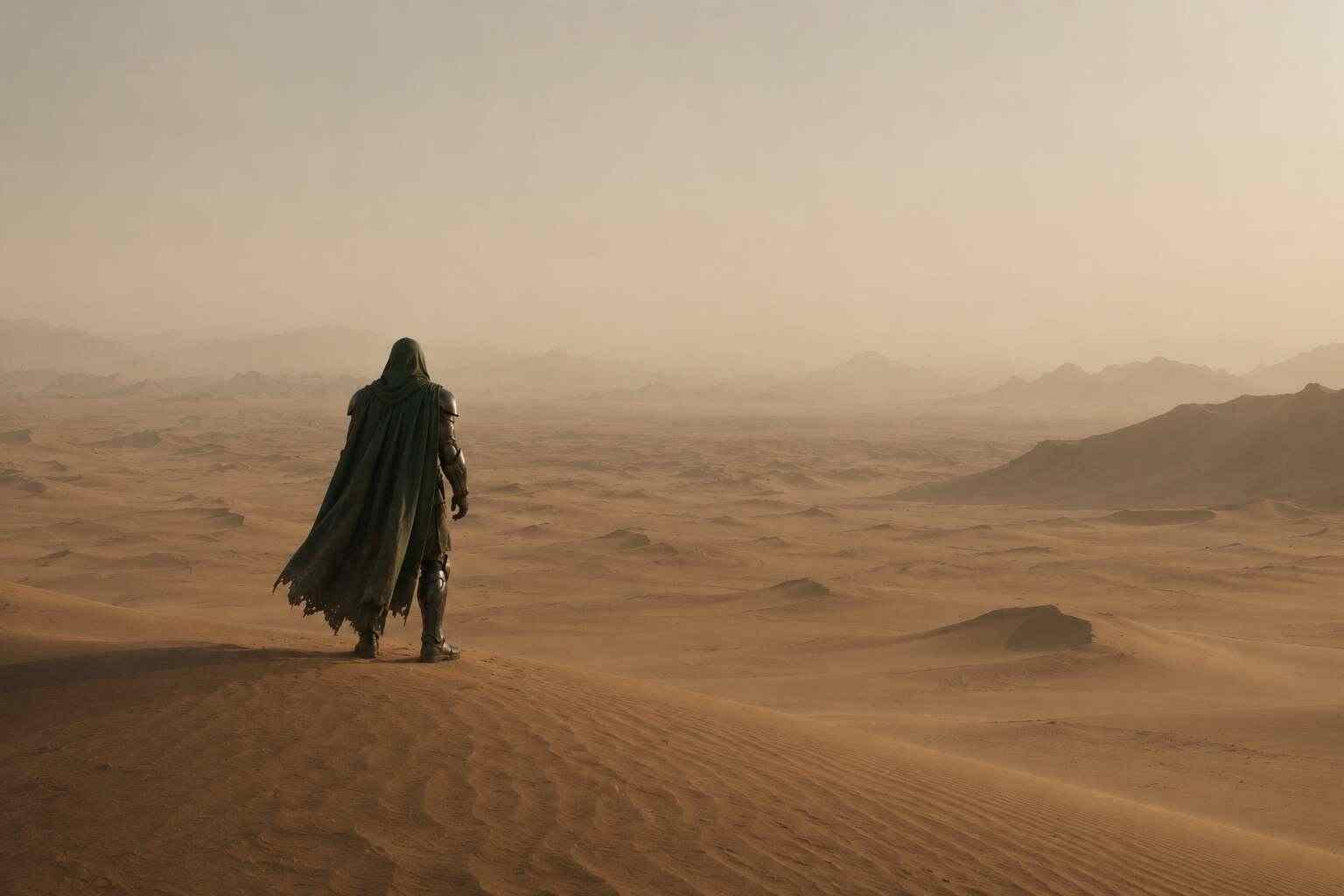
Photo: Unsplash — Desert expanse echoing the dunes of Arrakis
Avengers: Doomsday is the end of what Marvel calls the Multiverse Saga — a story that began in the post-Endgame MCU and has been building toward a convergence of the main MCU timeline (Earth-616), the Fantastic Four's universe (Earth-828), and the original Fox X-Men timeline. The film's central premise — three universes on a collision course — sets up everything that follows in the concluding chapter, Avengers: Secret Wars, arriving December 2027.
Dune: Part Three adapts Dune Messiah, Frank Herbert's 1969 sequel, set 17 years after the events of Part Two. The time jump finds Paul Atreides as the Padishah Emperor of the Known Universe, his terrible holy war already consuming the galaxy. This is not a triumph. It is a reckoning — for Paul, for the Fremen, and for the very idea of the chosen one.
"Beloved heroes from three distinct universes will be set on a deadly collision course and face an existential threat unlike anything they've ever encountered."
Marvel Studios — Official synopsis, Avengers: DoomsdayOfficial Teaser Trailer #1 — Avengers: Doomsday (Movieclips Trailers · YouTube · Dec 23, 2025)
Between these two films, December 18, 2026 assembles a cast so deep it is difficult to comprehend. Doomsday is officially the MCU's largest ensemble ever — drawing from the Avengers, Fantastic Four, Thunderbolts, and the original Fox X-Men. Dune brings back its entire core company while adding Robert Pattinson as the menacing shapeshifter Scytale and Anya Taylor-Joy returning from Part Two.

Photo: Unsplash — Red carpet energy ahead of December 18
Cinema has not seen a December like this since the golden era of must-see blockbusters. Whatever the box office math produces, both films arrive carrying the weight of franchises and the hopes of millions of fans worldwide. Doomsday is Marvel's statement that it still matters. Dune Part Three is Villeneuve's farewell to Arrakis, shot with tools that didn't exist when he began. They are not rivals — they are the rare simultaneous argument that movies, made at this scale, can still be genuinely worth the journey to the theatre.
Comments (0)
Be the first to comment.
Leave a comment